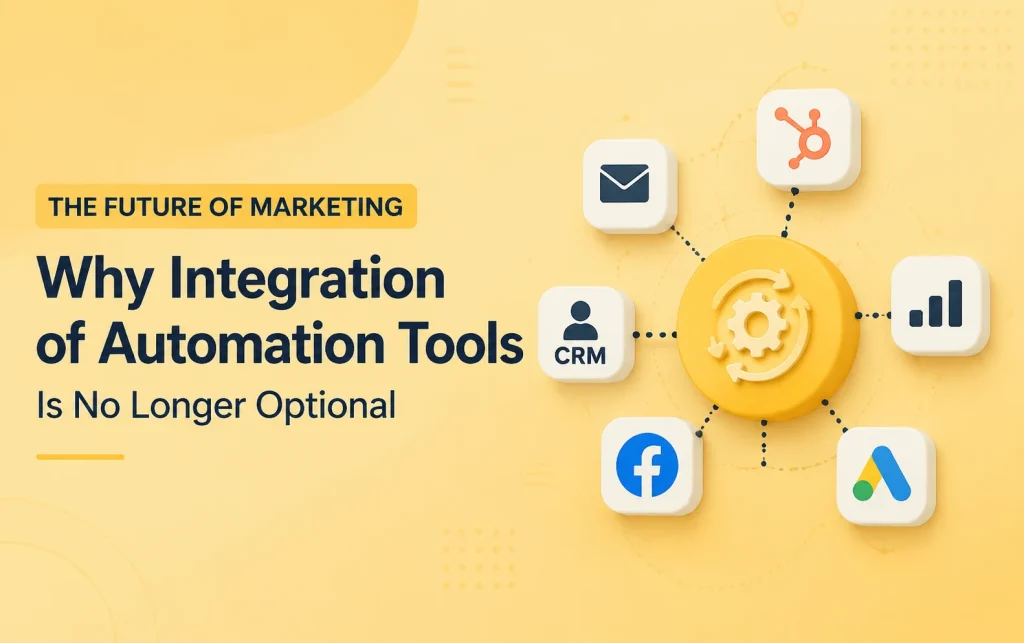
The Future of Marketing: Why Integration of Automation Tools Is No
Longer Optional
Marketing is in a revolutionized state in only the past few years. Customers want brands to
recall their preferences, follow up immediately, and deliver frictionless experiences via email,
social and beyond. On the business side, no single, isolated system is able to satisfy such
requirements. The solution? Integration.
The integration of marketing automation tools is no longer the nice-to-have, it has become the
way to build modern marketing. No matter if you are a startup or an enterprise, connecting your
tools enables efficiency, clarity and the capability to scale.
Key Takeaways:
The marketing is no longer a choice of integration there are. Companies that have integrated
technologies experience lower risks of being left behind in the current digital economy through
integration of fragmented tools. Linked systems provide customers with a great experience,
improved efficiencies and release teams to work without manually doing tasks.
Integrated data eliminates silos, allows real-time reporting and preconditions the transition to
AI-enabled automation. In usual words, integration is the solution to smarter decision making
and a future ready marketing.
Introduction to Integration
Integration in marketing is not merely an addition of a new tool to your marketing stack. It is
the strategy of making your CRM, email marketing, social sites, analytics and Ad systems
interact with one another. When tools exchange data it is possible to have a birds-off view on
every customer touchpoint effectively impossible when tools are separated.
Why Integration Is Now Non-Negotiable
Today, the customer wants a personalised and consistent experience at all touch points.
Regardless of whether they engage your brand on social media, via email, or on a website, they
do not want to feel like a name on a list. Integration achieves this by aligning all the channels
to the similar message and customer data is conveyed uniformly. It also completely removes
data siloes, combining your analytics, CRM and campaigns into a single dashboard. Having a
unified view of customer behavior can assist a marketer to gain invaluable insights on customer
behavior thereby providing customer experience that develops trust and loyalty.
Other than customer engagement, the point of integration is efficiency and more intelligent
decision-making. Manual exportation and detached workflow is a waste of time and in many
cases, it is prone to making mistakes. Automating across different platforms helps teams devote
less time to routine jobs leaving them with more time to be creative and strategic. The
advantage of integrated systems is that they offer real-time results so marketers can make
improvements immediately, get the most out of marketing and then remain flexible in the
dynamic digital market.
Key Integration Capabilities & Tool Ecosystems
Such platforms as HubSpot, ActiveCampaign, Marketo, and Go HighLevel are ahead of the
curve by allowing native integrations. Where no native connection exists, use middleware such
as Zapier or Make (formerly Integromat) to work around the lack of a native connection. It is
an obvious trend, and the future is all-in-one ecosystems in which businesses can gather leads,
automate follow-up, create campaigns and analyze results without switching between disparate
apps.
How to Integrate Effectively
The initial process of streamlining your marketing stack is starting by auditing your marketing
tools. Find out where which are really the essential ones, and which ones are overlapping or
redundant. At that point, select network providers that allow good native connection in order
to reduce third-party connector dependencies on platforms. It is also necessary to map out the
workflows to make sure that data moves freely between the systems and supports your overall
marketing objectives. And lastly, begin with something simple like linking some of your most
influential tools i.e. CRM tool, email and advertising tools. You can scale your integrations
after testing out.
Pitfalls to Avoid
The most frequent error that companies make when navigating towards integration is, that they
overcomplicate their stack. The use of too many tools is confusing and non-clarity. The other
problem is disregarding data hygiene Ineffective data transfers among systems compound the
number of errors. Lastly, even the most well-done integrations may not work in the long-term
unless your staff has been trained to make use of the integrations. The integration of systems
does not happen as a result of a technology as much as it does with people.
Looking Ahead: Integration and AI-Driven Workflows
AI is transforming the face of marketing, not to mention that it is not sufficient in and of itself.
High-quality and connected data is required when creating predictive analytics algorithms,
automatized personalization experiences, and intelligent chatbots. AI tools are useless without
in-built systems to provide them with pertinent information. Integration preconditioned the
work of AI at its best level.
Alternatives and Supporting Tools
A full-stack solution is not experienced or welcome by every business. When this is the case,
many middleware tools, such as Zapier, Make, or Workato can help deliver a cost-efficient
alternative to integrating new systems. Such elastic solutions serve as the optimal transition
steps, permitting companies to incrementally scale to a full integrated ecosystem, as their
requirements
change.
Conclusion: The Future Is Integration
The future of marketing is not only digital, but it is integrated. Companies that integrate their
automation technology will be faster, strategically informed, and will see greater customer
retention than those that do not. It has never been more necessary to review your tools, integrate
your systems, and be ready for the future of marketing. Integration is not a choice- it is what
allows growth. This mindset is enshrined in how we assist clients to grow within Growth Guild,
and other progressive agencies, as well. At the heart of this computation is crafting seamless
systems to make brands more efficient, deliver personalized experiences, and tap into the
potential of automation to win the game in the new world of increasing mobility.
FAQ
What does integrating marketing automation tools mean?
It means connecting your tools (CRM, email, analytics, social, etc.) so data flows seamlessly
across them.
Why is integration important for small businesses?
It saves time, reduces errors, and allows small teams to deliver personalized marketing without
being overwhelmed. .
Do I need expensive software to integrate?
Not always. Tools like Zapier or Make can connect platforms affordably, and many CRMs
offer native integrations.
How do I know if my tools need integration?
If you’re manually moving data between platforms, missing customer insights, or struggling
with inconsistent messaging-you need integration.
What’s the future of marketing automation?
The future is AI-driven personalization, but it will only work effectively if your tools are
already
integrated.
From smoothing out operations to catching potential roadblocks before they surface, Arham is
quietly steering the ship in the background ensuring both the client and the team are always in
sync. He keeps communication clear, proactive, and on track, so no one’s left wondering where
things stand. If Growth Guild had a Hogwarts equivalent, Arham would be the one running
logistics behind the curtains—spell-free, but somehow always ten steps ahead.
Abdullah Hassan
Automation and Training Lead
Abdullah doesn’t just train people at GG—he trains systems. Whether it’s automation logic, or
backend workflows, he’s built a reputation for solving problems most avoid. From mentoring new
hires to debugging complex setups, he brings clarity to chaos and precision to every process.
Reliable, resourceful, and quietly relentless—he’s one of the engines keeping the backend
running.
Muhammad Hassam
HR Specialist
From recruiting top talent to shaping culture, check-ins, and everything in between, Hassam
ensures Growth Guild runs smoothly, on paper and in practice.
With a naturally structured and organized approach, he builds systems that support scale, not
just hiring. Whether it’s streamlining processes, resolving team concerns, or aligning people with
the bigger picture, Hassam keeps the human side of Growth Guild just as optimized as the tech.
He ensures that members of our GG Family aren’t just managed, they’re empowered.
Salman Sohail
Media Buying Team Lead
His eye for performance and his obsession with campaign metrics make him the lead who
doesn’t just launch ads but he studies them, optimizes them, and turns them into proof of
concept. Salman treats campaigns like puzzles which are built to be cracked, tested, and rebuilt
better. He’s constantly experimenting, tweaking offers, angles, and audiences until the numbers
start saying what he wants to hear. Bad CPL? He sees it as an open challenge. Great CPL?
That’s where he starts getting excited.
Konain Riaz
Creatives Manager
Whether she’s leading a campaign or curating moodboards at midnight, one thing’s certain:
Konain doesn’t miss. Powered by black coffee and post-gym adrenaline, she shows up with
energy, vision, and a style that’s as sharp as her creative eye. Beneath the social charm is a
creative lead managing shoots, edits, visuals, and client expectations all at once—and making it
look effortless. Konain brings vision to life, balancing big ideas with sharp execution, tight briefs
with tighter deadlines, and creative chaos with clean, on-point delivery.
Aasaish Ali
GHL Team Lead
Whether it’s designing high-conversion automations or troubleshooting complex workflows in
GHL, Aasaish gets it done before most even figure out where to start. He leads with sharp
structure and sharper instincts. His approach to tech is aggressive, fast, and unapologetically
detail-obsessed. He doesn’t just build bots—he builds ecosystems. From Make.com to Vapi, if it
can be automated, Aasaish has already mapped it out.
Aayzah Fatima
GHL Team Lead
Ayzah leads with quiet confidence and a clear sense of purpose. She maintains a strong
command over her work, balancing precision and consistency across every project she takes
on. Her approach is measured, thoughtful, and deeply intentional—never rushed, never
reactive. Ayzah’s leadership is calm, focused, and rooted in humility—delivering results without
the need for noise.
Ifrah Sehar
GHL Team Lead
Ifrah brings a thoughtful kind of leadership to the team, where empathy meets execution and
every decision is made with people in mind. Clients connect with her instantly, and teammates
trust her instinctively. While she leads with quiet confidence on the outside, her thoughtfulness
runs even deeper. Quick to build trust, consistent with follow-through—Ifrah makes it all look
easy, without ever needing to say much.
Umer Imran
GHL Team Lead
Umer joined the Growth Guild family as a fresh graduate but he never showed up like one. He’s
the kind of person who leans into challenges most would avoid, and stays locked in when the
margin for error is zero. Known for being detail-driven and execution-focused, Umer isn’t the
loudest voice in the room—but his work speaks clearly. Nothing slips past him, and nothing is
delivered until it meets his standard.
Kainaat Mahar
GHL Team Lead
Kainaat doesn’t just manage a team, she leads with purpose. What started as a
behind-the-scenes presence in the agency quickly grew into a leadership role managing 15+
associates with clarity, empathy, and a focus on continuous growth.
She’s big on culture, serious about learning, and intentional about making people feel like they
belong. From optimizing automations to organizing spontaneous team activities, Kainaat knows
that strong systems and stronger teams go hand in hand
Hammad Zafar
Sales Manager
With hands-on GHL expertise, Hammad doesn’t rely on scripts but he sells with precision. His
conversations don’t feel like sales calls, They feel more like conversations with someone who’s
already halfway to the solution. He cuts through the noise, understands exactly what the client
needs, and positions the offer with clarity and speed. With a sharp eye for people and an even
sharper grasp of numbers, he’s built for high-stakes deals and decisions that can’t afford delays.
Shaheer Butt
Chief Technology Officer
Shaheer is one of Pakistan’s first GHL Certified Admins and he’s been raising the bar ever
since. Originally brought in by Saad for a one-off project, it didn’t take long to realize he wasn’t
just solving problems—he was redefining the way systems could be built.
As Growth Guild’s CTO, Shaheer leads everything behind the build: automations, integrations,
infrastructure, and scale. He engineers custom workflows using tools like Vapi, Make.com,
Zapier, Closebot, ZappyChat, n8n, and a growing arsenal of other platforms each wired into
systems that feel seamless on the front, and bulletproof at the back.
His fluency in tech and bots is unmatched and so is his obsession with turning complexity into
clarity. He doesn’t just talk about systems but he builds the kind that keeps the entire agency
running, quietly and flawlessly.
Talha Saeed
Chief Operating Officer
What started as a project turned into a partnership—and then into an operation built from the
ground up. Talha joined Growth Guild in July 2023 with one mission: to turn vision into structure.
Today, he’s the architect behind the systems, processes, and operational backbone that keep
the agency sharp, scalable, and always moving forward.
With 5+ years of media buying experience and over $100,000 per month in managed ad
spend across Meta, Google, and other performance channels, Talha brings hard data into
every decision. He doesn’t just launch campaigns but he scales them, tracks every metric that
matters, and cuts what doesn’t convert.
While others focus on ideas, he obsesses over execution bringing clarity to chaos, strategy to
ambition, and structure to every moving part of the agency. He’s always testing, tweaking, and
thinking in systems. Friendship may have sparked the idea but Talha made sure the foundation
could actually scale.
Saad Ahsan
Chief Executive Officer
"Growth Guild wasn’t built overnight—every step was intentional, every win earned."
Saad didn’t just lead it. He architected every layer of it. Today, that vision drives a team of 100+ people and counting—what we call the Growth Guild family.
Saad Ahsan is the driving force behind Growth Guild. With a vision that was as clear as it was ambitious, he launched the agency on June 1st, 2023, and built it from the ground up into a high-performance operation spanning sales, creative, automation, and management.
His leadership is defined by sharp execution, strategic clarity, and an unshakable standard for excellence. Saad doesn’t chase trends—he identifies what works, scales it, and moves fast. Sales is his stronghold, strategy is second nature, and results are the only language he operates in.