How to Audit Your Paid Media Campaigns Before Increasing the Budget
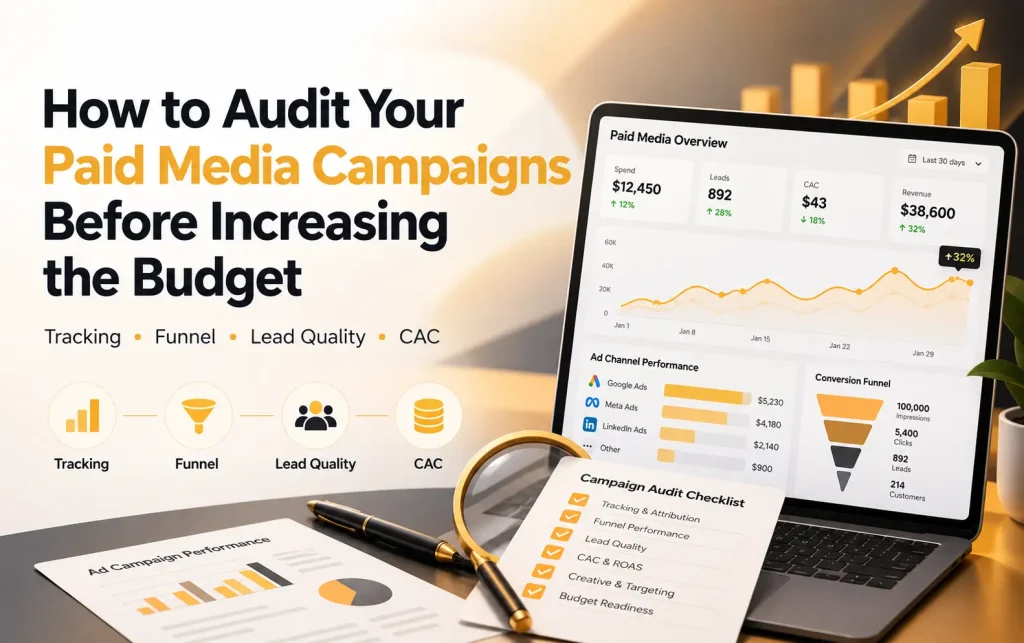
Increasing an advertising budget can accelerate growth but it can also accelerate wasted spending.
A campaign generating leads at a reasonable cost may look ready to scale, but performance numbers alone do not tell the whole story. Before increasing spend, businesses need to understand whether the campaign is actually profitable, whether tracking is accurate, whether leads are high quality, and whether the underlying funnel can handle additional volume.
This is where a structured paid media audit becomes essential.
Whether you manage campaigns internally or work with a media buying agency, auditing your campaigns before scaling can help identify tracking problems, weak creatives, poor-quality leads, inefficient audiences, and conversion bottlenecks.
Here is a practical framework you can use before increasing your budget.
1. Define What Success Actually Means
Start with the business outcome not the advertising platform.
Your campaign might be designed to generate:
- Leads
- Sales
- Appointments
- Phone calls
- Qualified opportunities
- Revenue
A campaign producing leads at $20 each is not necessarily better than one producing leads at $40. If the $20 leads rarely answer calls while the $40 leads consistently become customers, the second campaign may be far more valuable.
Before auditing performance, establish your target:
Target CPA + Target Lead Quality + Target Conversion Rate = Scaling Benchmark
Your advertising metrics should ultimately connect to revenue and profitability.
2. Verify Tracking and Attribution
Never scale a campaign until you know the data is trustworthy.
Review:
- Meta Pixel and Conversions API
- Google Ads conversion tracking
- GA4
- CRM source tracking
- UTM parameters
- Call tracking
- Form submissions
- Lead and purchase events
Look for:
- Duplicate conversions
- Missing events
- Incorrect event configuration
- Broken integrations
- Leads attributed to the wrong campaign
- Differences between advertising and CRM data
For example, if Meta reports 150 leads but your CRM contains only 100, determine why before making budget decisions.
Reliable tracking is the foundation of effective media buying services.
3. Audit the Entire Conversion Funnel
Your advertising campaign is only one part of the acquisition system:
Ad → Landing Page → Lead → Follow-Up → Appointment → Opportunity → Customer
Review conversion rates at each important stage.
For example:
- Click → Lead: 10%
- Lead → Qualified Lead: 40%
- Qualified Lead → Appointment: 50%
- Appointment → Customer: 30%
This gives you a much clearer picture than looking at CPL alone.
A campaign may generate inexpensive leads but still perform poorly if the landing page, sales process, or follow-up system cannot convert them.
Before scaling, identify the largest conversion bottleneck in the funnel and determine whether it is an advertising problem or an operational problem.
4. Evaluate Lead Quality and Customer Acquisition Cost
Lead quality should be a major part of every lead-generation audit.
Ask:
- Are leads answering calls?
- Are they in the correct location?
- Do they need the advertised service?
- Do they meet the target customer profile?
- Are they booking appointments?
- Are they becoming opportunities?
- Are they becoming customers?
Then calculate your actual customer acquisition cost.
CAC = Total Acquisition Cost ÷ New Customers
Do not rely solely on CPL or CPA if your business has a longer sales cycle.
A campaign producing 500 low-quality leads can be considerably worse than one producing 100 qualified opportunities.
Your CRM should ideally connect the original lead source with the eventual sales outcome. This allows your media buying agency to optimize toward business results rather than simply generating more form submissions.
5. Review Audience Targeting
Next, determine whether your campaigns are reaching the right people.
Depending on the platform, review:
- Geographic targeting
- Age and demographic targeting
- Interests
- Job titles
- Lookalike audiences
- Custom audiences
- Retargeting
- Broad targeting
- Exclusions
Look for audiences that consistently produce expensive or low-quality conversions.
Also check for unnecessary overlap. If multiple campaigns target essentially the same audience, you may create internal competition and make performance harder to interpret.
Do not automatically assume that a smaller audience is better. The right targeting strategy depends on the offer, market size, campaign objective, and available conversion data.
6. Audit Creative Performance and Fatigue
Creative performance should be evaluated beyond the campaign average.
Review:
- Hook
- Video or image
- Primary copy
- Headline
- Offer
- Call to action
- Format
- Audience
- Conversion quality
Identify which creatives generate meaningful business results—not simply clicks.
Also check for fatigue.
Warning signs include:
- Rising frequency
- Falling CTR
- Increasing CPC
- Increasing CPA
- Declining conversion rate
- Rising CPM
If a campaign has one winning creative doing most of the work, prepare additional variations before scaling aggressively.
A strong media buying agency should maintain a creative testing pipeline rather than depend indefinitely on one advertisement.
7. Check Landing Page and Offer Alignment
Paid traffic is expensive. Your landing page needs to deliver on the promise made by the advertisement.
Review:
- Headline
- Offer clarity
- Message match
- Mobile experience
- Page speed
- Form length
- CTA visibility
- Trust signals
- Testimonials
- Objection handling
Ask a simple question:
If someone clicks this ad, is it immediately obvious what they are getting and what they should do next?
If an advertisement promotes a specific offer but the landing page presents something unrelated, conversion rates can suffer.
Do not automatically blame the ads when the real problem is the page receiving the traffic.
8. Review Campaign Structure and Budget Allocation
Your account structure should make performance easy to understand.
Review:
- Campaign objectives
- Ad sets or ad groups
- Conversion events
- Audience organization
- Creative organization
- Naming conventions
- Budget distribution
Then classify campaigns into four categories:
Scale
Strong conversion performance, acceptable acquisition cost, and good lead quality.
Optimize
Promising performance with identifiable problems that can be fixed.
Test
Insufficient data or new campaigns that need additional information.
Reduce or Pause
Poor performance with no clear improvement path.
This gives you a more rational way to allocate budget instead of increasing spend across every campaign equally.
9. Check CRM and Sales Follow-Up
For lead generation campaigns, advertising performance cannot be separated from what happens after the lead arrives.
Review:
- Lead response time
- Call attempts
- SMS follow-up
- Email follow-up
- Appointment reminders
- Lead ownership
- Pipeline stages
- Call outcomes
For example:
Ad Lead → CRM → Immediate Response → Sales Call → Appointment → Follow-Up → Customer
If leads are not contacted quickly or are incorrectly routed, increasing ad spend may simply generate more neglected opportunities.
This is why a complete paid media audit should include the CRM and sales process, not just the advertising account.
10. Determine Whether the Campaign Is Ready to Scale
For lead generation campaigns, advertising performance cannot be separated from what happens after the lead arrives.
Review:
- Lead response time
- Call attempts
- SMS follow-up
- Email follow-up
- Appointment reminders
- Lead ownership
- Pipeline stages
- Call outcomes
For example:
Ad Lead → CRM → Immediate Response → Sales Call → Appointment → Follow-Up → Customer
If leads are not contacted quickly or are incorrectly routed, increasing ad spend may simply generate more neglected opportunities.
This is why a complete paid media audit should include the CRM and sales process, not just the advertising account.
Practical Paid Media Audit Worksheet
Use this worksheet before increasing your advertising budget.
Score each area from 1 to 5:
1 = Critical problem
2 = Needs improvement
3 = Acceptable
4 = Strong
5 = Ready to scale
Audit Area | What to Check | Score | Notes / Action |
Tracking | Pixel, CAPI, GA4 and conversion events | ___ | __________ |
Attribution | UTMs and CRM source tracking | ___ | __________ |
Funnel | Click → Lead → Customer conversion | ___ | __________ |
Lead Quality | Qualified leads and customer rate | ___ | __________ |
CAC | Cost to acquire actual customers | ___ | __________ |
Targeting | Audience quality and exclusions | ___ | __________ |
Creative | Winning ads and creative diversity | ___ | __________ |
Creative Fatigue | Frequency, CTR and CPA trends | ___ | __________ |
Landing Page | Speed, message match and conversion | ___ | __________ |
Campaign Structure | Objectives, audiences and organization | ___ | __________ |
Budget Allocation | Spend concentrated on winners | ___ | __________ |
CRM & Follow-Up | Response time and sales process | ___ | __________ |
Profitability | Revenue, margin and acquisition costs | ___ | __________ |
Scalability | Audience and operational capacity | ___ | __________ |
Audit Score
Add your scores together.
56–70: Ready to Scale
The campaign appears structurally healthy. Increase the budget gradually while monitoring performance.
42–55: Optimize Before Scaling
The campaign has potential, but one or more areas could limit growth. Fix the weakest areas first.
Below 42: Do Not Scale Yet
There are likely fundamental issues with tracking, lead quality, profitability, funnel performance, or campaign structure.
Identify Your Top Three Problems
Priority #1: ______________________________
Priority #2: ______________________________
Priority #3: ______________________________
Then define your scaling requirements:
Target CPA: ______________________________
Target conversion rate: ______________________________
Required lead quality: ______________________________
Next budget: ______________________________
Scaling condition: ______________________________
This turns an audit from a collection of metrics into a concrete decision-making process.
How a Media Buying Agency Can Help
A professional media buying agency should do more than launch and monitor advertisements.
The right partner should understand the complete acquisition system, including:
- Campaign strategy
- Audience targeting
- Creative testing
- Conversion tracking
- Landing pages
- CRM data
- Lead quality
- Sales conversion
- Budget allocation
This broader approach makes it easier to identify whether the advertising account is actually the problem.
For businesses investing in media buying services, this distinction is critical. Increasing the budget should be based on evidence not simply because a campaign has produced a few good days.
Final Thoughts
Scaling paid media should be treated as a business decision, not just an advertising decision.
Before increasing your budget, verify your tracking, evaluate lead quality, identify funnel bottlenecks, review creative performance, check your landing page, inspect CRM follow-up, and calculate the real economics of acquiring a customer.
If the system is healthy, scaling can generate more profitable volume.
If the system has underlying problems, increasing the budget can simply make those problems more expensive.
GrowthGuild helps businesses build and optimize paid media campaigns alongside CRM, automation, landing pages, and lead-management systems.
Before increasing your ad spend, make sure your campaign and the system behind it is ready to scale. Contact GrowthGuild for professional media buying services.
FAQs
1. How do you audit a paid media campaign?
Review tracking, funnel performance, targeting, creative, landing pages, lead quality, CRM follow-up, profitability, and scalability.
2. Should you increase your ad budget when ROAS is high?
Not automatically. Confirm that tracking, lead quality, conversion rates, profitability, and operational capacity remain healthy.
3. What metrics should you check before scaling paid ads?
Review CTR, CPC, CPM, CPL, CPA, conversion rates, qualified lead rate, CAC, ROAS, and revenue.
4. Why should lead quality be checked before increasing ad spend?
More advertising spend can produce more low-quality leads. Evaluate whether leads become qualified opportunities and customers.
5. What does a media buying agency audit?
A media buying agency can audit campaigns, targeting, creative, tracking, landing pages, lead quality, CRM follow-up, attribution, and budget allocation.