AI Account Manager vs Human Account Manager: What Can AI Actually Handle
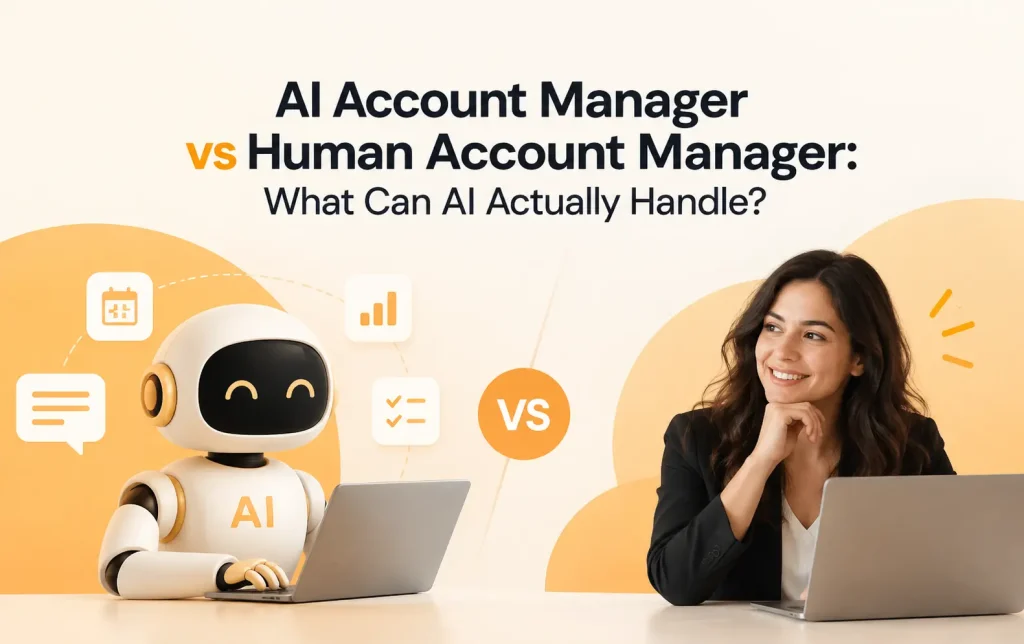
Account management is changing.
Businesses and agencies are increasingly using artificial intelligence to handle repetitive communication, organize customer information, send follow-ups, schedule meetings, and support day-to-day client operations.
This has led to an important question:
Can an AI account manager actually replace a human account manager?
The short answer is: not completely.
AI can handle many repetitive and process-driven account management responsibilities, but human account managers remain essential for strategy, relationship building, complex decisions, conflict resolution, and situations that require judgment.
The most effective approach for many businesses is not choosing between AI and humans. It is combining both.
An AI account manager can handle repetitive operational work while a human account manager focuses on the parts of the relationship that require experience, empathy, and strategic thinking.
What Is an AI Account Manager?
An AI account manager is an AI-powered system designed to support or automate account management activities.
It can connect with tools such as a CRM, communication platform, calendar, project management system, and reporting tools to perform predefined tasks.
Depending on the technology and implementation, an AI account manager can help with:
- Client communication
- Follow-up messages
- Appointment scheduling
- CRM updates
- Task creation
- Status notifications
- Frequently asked questions
- Meeting summaries
- Reporting summaries
- Lead qualification
- Information collection
- Internal notifications
The exact capabilities depend on how the AI system is configured.
It is important to understand that “AI account manager” is not a standardized job title. In practice, it can refer to anything from an AI assistant supporting an account manager to a more advanced agent capable of performing multiple account-related tasks.
What Does a Human Account Manager Do?
A human account manager typically acts as the primary relationship owner between a company and its client.
Their responsibilities can include:
- Understanding client objectives
- Managing expectations
- Communicating project progress
- Coordinating internal teams
- Identifying account risks
- Handling complaints
- Providing strategic recommendations
- Reviewing performance
- Discussing opportunities
- Managing renewals
- Building long-term relationships
A human account manager does not simply pass information between the client and the company.
They interpret information, understand context, make decisions, and often become the person the client trusts when something goes wrong.
That human relationship remains difficult to replicate completely with automation.
AI Account Manager vs Human Account Manager
Responsibility | AI | Human |
Routine follow-ups | Excellent | Yes |
Appointment scheduling | Excellent | Yes |
CRM updates | Excellent | Yes |
FAQ responses | Excellent | Yes |
Meeting summaries | Excellent | Yes |
Status notifications | Excellent | Yes |
Data collection | Excellent | Yes |
Reporting summaries | Strong | Strong |
Strategic recommendations | Limited | Excellent |
Complex negotiations | Limited | Excellent |
Conflict resolution | Limited | Excellent |
Relationship building | Limited | Excellent |
Sensitive conversations | Limited | Excellent |
Business judgment | Limited | Excellent |
The distinction is important.
AI is strongest when the process is predictable and the required outcome is clearly defined.
Humans are strongest when the situation requires context, judgment, creativity, empathy, or accountability.
Learn More about account management for GHL Account: https://growthguild.us/what-does-a-gohighlevel-manager-do/
What Can an AI Account Manager Actually Handle?
1. Routine Client Follow-Ups
One of the simplest applications is automated follow-up.
For example, an AI system can send a message when:
- A document is missing
- A task requires approval
- A meeting is approaching
- A milestone has been completed
- A client has not responded
- Additional information is required
Instead of an account manager manually remembering every follow-up, the system can handle routine communication automatically.
2. Appointment Scheduling
An AI system can communicate with clients and help schedule meetings based on configured availability.
For example:
Client: “Can we schedule a call next week?”
AI: Checks available calendar times and provides suitable options.
Once the client selects a time, the system can confirm the meeting and update the relevant CRM record.
This is particularly useful for agencies managing many accounts.
3. CRM Management
An AI account manager can help keep CRM records updated.
Depending on the connected systems, it can:
- Add notes
- Update contact information
- Record conversation details
- Update opportunity stages
- Create tasks
- Apply tags
- Store customer responses
This reduces manual data entry and gives human account managers more time to focus on client-facing work.
4. Client Information Collection
AI can collect routine information from clients through chat, email, forms, or voice interactions.
For example, before launching a campaign, an AI system could request:
- Brand assets
- Website access
- Business information
- Target audience
- Service details
- Campaign objectives
The system can then record the information and notify the appropriate team member when everything has been received.
5. FAQ and Status Questions
Clients often ask the same basic questions repeatedly.
Examples include:
- When is our next meeting?
- Did you receive the document?
- What is the status of our campaign?
- What information do you need from us?
An AI system can answer these routine questions when the necessary information is available.
This can reduce unnecessary interruptions for human account managers.
What Should a Human Account Manager Still Handle?
1. Strategic Recommendations
AI can summarize data, identify patterns, and generate possible recommendations.
But important strategic decisions should still involve human oversight.
For example:
“Should we increase our advertising budget by 40%?”
That decision may depend on profitability, sales capacity, market conditions, customer quality, cash flow, and business objectives.
A human strategist can consider those factors together.
2. Difficult Client Conversations
Not every client interaction should be automated.
Situations involving:
- Complaints
- Refunds
- Missed deadlines
- Poor performance
- Contract disputes
- Major service problems
- Relationship concerns
usually require human involvement.
A client who is frustrated may not want to communicate with an automated system.
3. Relationship Building
Strong account management is partly about understanding the person behind the business.
A human account manager may know:
- The client’s communication preferences
- Their business priorities
- Their concerns
- Their internal politics
- Their long-term goals
- Their previous experiences
This context helps create stronger relationships.
AI can assist with the information, but humans remain better positioned to build genuine professional relationships.
4. Negotiation and Decision-Making
Negotiating pricing, contracts, scope, deadlines, or strategic changes requires authority and judgment.
An AI system can prepare information for the conversation, but a human should generally own important commercial decisions.
The Best Model: AI + Human Account Management
The most practical approach for many businesses is a hybrid system.
Instead of:
AI vs Human
Think:
AI + Human
The AI handles repetitive operational work.
The human handles strategy and relationships.
For example:
Step 1: Client Sends a Request
AI receives and categorizes the request.
Step 2: AI Checks Available Information
It reviews the CRM, project status, calendar, or knowledge base.
Step 3: AI Handles Routine Requests
If the request is straightforward, AI responds automatically.
Step 4: Complex Request Is Escalated
If the issue requires judgment, the AI creates a task for the human account manager.
Step 5: Human Takes Over
The account manager handles the conversation and makes the necessary decision.
Step 6: AI Handles the Follow-Up
After the decision, AI can update the CRM, send confirmation, create tasks, and schedule follow-ups.
This creates a division of responsibilities based on what each system does best.
How GoHighLevel Can Support AI Account Management
For businesses using GoHighLevel, AI account management can become part of a broader CRM and automation system.
A typical process could look like:
Client Message → AI → GoHighLevel CRM → Identify Request → Automated Response or Human Escalation → Task/Update → Follow-Up
For example, a client asks for an appointment.
The AI can identify the request, check the appropriate calendar, schedule the meeting, update the CRM, and send confirmation.
Another client may report a serious campaign issue.
Instead of attempting to solve it automatically, the system can create a task for the human account manager and provide a summary of the conversation.
This makes AI a productivity layer rather than a replacement for the entire account-management function.
Benefits of Using an AI Account Manager
Faster Response Times
AI can respond immediately to routine requests rather than waiting for an account manager to become available.
Reduced Administrative Work
Account managers spend less time updating CRM records, sending reminders, and collecting information.
Consistent Follow-Up
Automated systems do not forget routine follow-up tasks.
Better Scalability
One team can potentially manage more accounts when repetitive work is automated.
Centralized Information
AI can work with CRM and business data to help keep customer interactions organized.
More Time for Strategic Work
When administrative tasks are automated, human account managers can spend more time on strategy, client relationships, and revenue opportunities.
Risks of Relying Too Heavily on AI
AI account management also has limitations.
Incorrect Information
If the system has outdated or incorrect information, it may provide an inaccurate response.
Poor Escalation
An AI system needs clear rules for when to involve a human.
Lack of Context
AI may not understand every relationship nuance or business consideration.
Over-Automation
Automating every client interaction can make the experience feel impersonal.
Privacy and Access
Businesses need appropriate controls around the customer information AI systems can access and use.
The solution is not avoiding AI altogether. It is defining clear boundaries and maintaining human oversight where it matters.
How to Decide What to Automate
A simple rule can help:
Automate When:
- The process is repetitive
- The outcome is predictable
- The required information is available
- The risk of an incorrect decision is low
- A clear set of rules can define the action
Keep Human Oversight When:
- The situation is sensitive
- The decision has financial consequences
- The customer is unhappy
- Strategic judgment is required
- Information is incomplete
- The relationship is particularly important
This framework can prevent businesses from automating processes simply because they can.
What Will Account Management Look Like in the Future?
The account manager role is likely to become increasingly AI-assisted.
Instead of spending most of the day on administrative work, account managers may spend more time:
- Reviewing AI-generated insights
- Making strategic decisions
- Managing important client conversations
- Identifying expansion opportunities
- Solving complex problems
- Building relationships
AI can handle more of the operational workload while humans become more focused on judgment and relationship management.
The result is not necessarily fewer account managers. It can mean more capable account managers managing larger portfolios without sacrificing service quality.
Final Thoughts
An AI account manager can handle a surprising amount of repetitive account-management work, including follow-ups, scheduling, CRM updates, information collection, routine questions, and task creation.
But AI should not be treated as a universal replacement for human account managers.
Humans remain essential for strategy, relationship building, complex decisions, negotiation, sensitive conversations, and accountability.
For most businesses, the strongest model is a hybrid approach:
AI handles repetitive work. Humans handle the relationships and decisions.
GrowthGuild helps businesses and agencies connect AI, GoHighLevel CRM, automation, lead management, and client workflows into scalable operating systems.
If your account managers are spending too much time on repetitive administrative work, the opportunity may not be to replace them—it may be to give them an AI system that handles the work they shouldn’t have to do manually.
Ready to explore AI-powered account management? Contact GrowthGuild to design an automation system around your existing client-management process.
FAQs
1. What is an AI account manager?
An AI account manager is an AI-powered system that assists with tasks such as client communication, follow-ups, scheduling, CRM updates, information collection, and routine account management.
2. Can AI replace a human account manager?
AI can automate many repetitive account-management tasks, but humans remain important for strategy, relationship building, complex decisions, negotiations, and sensitive client situations.
3. What tasks can an AI account manager automate?
Common tasks include appointment scheduling, routine follow-ups, CRM updates, client information collection, FAQs, reminders, task creation, and status notifications.
4. Is AI account management suitable for agencies?
Yes. Agencies can use AI to automate repetitive client communication, CRM management, reporting support, onboarding, scheduling, and follow-up across multiple accounts.
5. What is the best approach to AI account management?
A hybrid approach is often most effective: AI handles predictable administrative tasks while human account managers handle strategy, relationships, complex issues, and important decisions.