Google Business Profile Optimization: 15 Things Local Businesses Should Fix
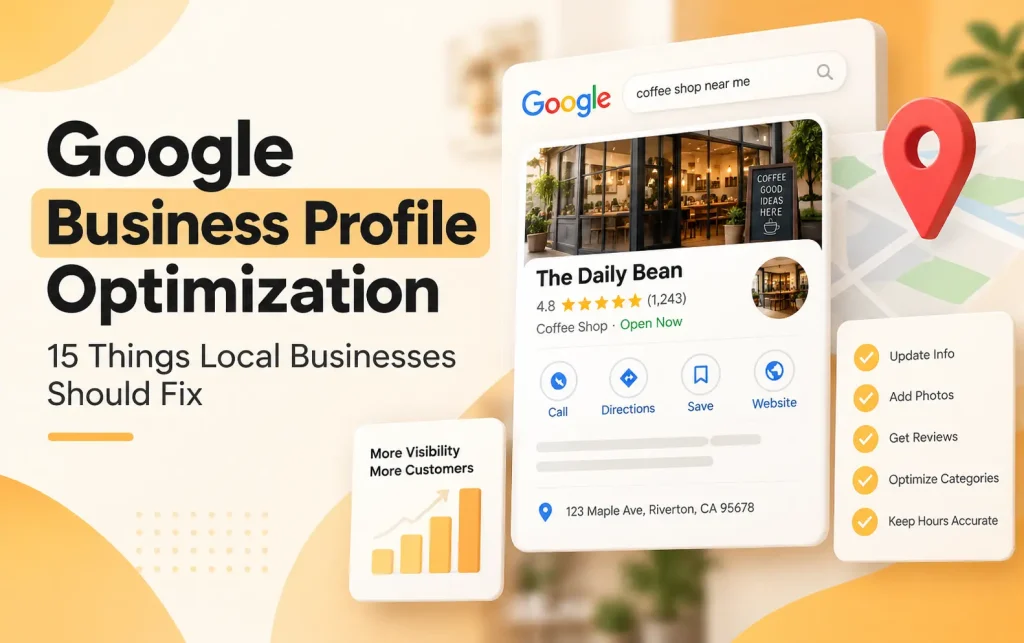
When someone searches Google for a local business, they may never visit the company’s website before deciding who to call.
They might see a Google Business Profile, compare reviews, check business hours, look at photos, visit the website, and call directly from the search results.
That makes Google Business Profile optimization an important part of local SEO.
For businesses that depend on customers in specific geographic areas such as HVAC companies, plumbers, roofers, electricians, painters, contractors, cleaning companies, realtors, and other local service providers a well-optimized profile can help turn local searches into calls and leads.
However, many businesses create their Google Business Profile once and rarely update it.
That can leave important information incomplete, outdated, or poorly optimized.
Here are 15 things local businesses should check and fix.
1. Verify Your Business Information
Start with the basics.
Your Google Business Profile should accurately represent your business.
Check your:
- Business name
- Address
- Phone number
- Website
- Business hours
- Service areas
Make sure the information matches your website and other important business listings.
If your phone number changed six months ago but your Google profile still shows the old number, potential customers may not be able to reach you.
Accurate information is the foundation of effective Google Business Profile SEO.
2. Choose the Most Relevant Primary Category
Your primary business category helps Google understand what your business does.
Choose the category that most accurately represents your core business.
For example, a plumbing company should select the most appropriate plumbing related category rather than choosing a broad category simply because it sounds relevant.
Your category should reflect your actual business, not the keyword you wish you could rank for.
Also review whether relevant secondary categories are available and appropriate.
Don’t add categories simply to target additional keywords.
3. Complete Your Business Description
Your business description gives potential customers additional context about what you offer.
Use it to explain:
- What your company does
- Which services you provide
- Where you operate
- Who you serve
- What makes your business different
Write naturally for customers.
Don’t turn the description into a list of repetitive keywords.
For example, instead of writing:
“Best plumber plumber plumbing plumbing services…”
Explain the actual services and geographic areas the business serves.
Good local SEO content should be useful first and optimized second.
4. Add Every Relevant Service
Many businesses overlook the services section of their profile.
If your company provides multiple services, make sure the relevant ones are represented.
For example, an HVAC company might offer:
- AC repair
- AC installation
- Furnace repair
- HVAC maintenance
- Indoor air quality
- Commercial HVAC
A roofing company could include:
- Roof repair
- Roof replacement
- Roof inspections
- Storm damage repair
- Commercial roofing
Accurate service information helps potential customers understand whether your business can solve their specific problem.
5. Keep Your Business Hours Accurate
Incorrect business hours can cost you customers.
Check:
- Normal operating hours
- Holiday hours
- Emergency availability
- Special hours
- Seasonal changes
This is particularly important for businesses that offer emergency services.
Imagine someone searches for an emergency plumber at 9 PM, sees that your profile says you’re closed, and calls a competitor instead.
Keeping your profile current is a simple optimization that can have a direct impact on customer experience.
6. Add High-Quality Business Photos
Photos help customers understand what your business looks like and what you actually do.
Depending on the business, consider adding:
- Team photos
- Office photos
- Vehicles
- Equipment
- Completed projects
- Before-and-after images
- Products
- Work environments
For home service businesses, project photos can be particularly valuable.
A roofer can showcase completed roofs.
A painter can showcase finished interiors.
A contractor can showcase remodeling projects.
A cleaning company can showcase completed work.
Use real business photos whenever possible rather than generic stock imagery.
7. Build a Consistent Review Strategy
Reviews are one of the first things potential customers may examine when comparing local businesses.
Create a consistent process for requesting genuine reviews from customers after completing a service.
For example:
Service Completed → Customer Follow-Up → Review Request
Don’t buy fake reviews or create reviews yourself.
Instead, make it easy for real customers to share their experiences.
You should also respond professionally to reviews.
Thank customers for positive feedback and address legitimate concerns appropriately.
Reviews aren’t simply an SEO task; they are part of your conversion strategy.
8. Respond to Customer Questions
Google Business Profiles can include customer questions and answers.
Businesses should monitor this section and provide accurate responses to common questions.
Potential customers may want to know:
- Do you offer emergency service?
- What areas do you serve?
- Do you provide free estimates?
- Do you offer financing?
- Are appointments required?
- Do you serve commercial customers?
Providing useful answers can reduce uncertainty and help customers decide whether to contact you.
Make sure answers are accurate and don’t use the section as a place to stuff keywords.
9. Add Relevant Attributes
Depending on the business category, Google may provide attributes that communicate useful information.
These can include information related to:
- Accessibility
- Payment options
- Service options
- Amenities
- Business characteristics
Review the available attributes and select only those that accurately describe your business.
Small details can help customers determine whether your business meets their needs.
10. Make Sure Your Website Is Optimized for Local Search
Your Google Business Profile does not exist independently from your website.
Your website should clearly communicate:
What you do + Where you operate + How customers can contact you.
Make sure important service pages include relevant information about the services and locations you actually serve.
For example:
HVAC Repair in Dallas
Roof Replacement in Phoenix
House Painting in Austin
Commercial Cleaning in Denver
Don’t create low-quality location pages simply by changing the city name.
Each page should provide genuinely useful information.
For a broader explanation of what small businesses should expect from an SEO investment, see GrowthGuild’s SEO services cost guide: SEO Services Cost for Small Businesses in the USA
11. Optimize Your Local Service Pages
Your service pages should support the searches your customers actually make.
A local business may have separate pages for:
- Services
- Service areas
- Emergency services
- Commercial services
- Residential services
For example, a plumbing company might have dedicated pages for water heater repair, drain cleaning, emergency plumbing, and sewer services.
Each page should have a clear purpose and a strong call to action.
The goal is not simply to rank the page.
The goal is to turn search visibility into:
Calls → Forms → Appointments → Customers
12. Check Your Name, Address, and Phone Consistency
Your business information should be consistent across important online properties.
Check your:
- Google Business Profile
- Website
- Business directories
- Social profiles
- Industry listings
- Local directories
Pay particular attention if your company has:
- Changed its name
- Moved locations
- Changed phone numbers
- Rebranded
- Added locations
Inconsistent information can create confusion for both customers and businesses managing their local presence.
13. Publish Useful Local Content
Your website should answer questions that potential customers in your market actually ask.
For example, a roofing company could publish:
What Should You Do After a Hailstorm Damages Your Roof?
An HVAC company could publish:
How Often Should You Service Your AC in a Hot Climate?
A realtor could publish:
What Should First-Time Buyers Know About Buying a Home in [City]?
A cleaning company could publish:
How Often Should Businesses Schedule Professional Office Cleaning?
This type of content can support broader local SEO efforts while demonstrating expertise.
For a deeper look at how local search can generate calls for service businesses, connect this article to the supporting guide “Local SEO for Home Service Businesses: How to Generate More Calls From Google” once Blog #27 is published.
14. Add Clear Calls to Action
Getting someone to your Google Business Profile is only the beginning.
Your website should make the next step obvious.
Depending on your business, use calls to action such as:
- Call Now
- Get a Free Estimate
- Request a Quote
- Schedule an Appointment
- Book a Consultation
- Get Started
- Contact Us
Don’t make visitors search for your phone number or contact form.
For local businesses, especially home service companies, the path from search to contact should be as simple as possible.
15. Track Calls, Leads, and Conversions
The final mistake is measuring only rankings.
Rankings matter, but they are not the ultimate business goal.
Track:
- Phone calls
- Form submissions
- Appointment requests
- Quote requests
- Contact form leads
- Organic traffic
- Local search visibility
- Qualified leads
- Customers generated
This helps answer the most important question:
Is your local SEO generating business?
A business ranking first for a low-value keyword may generate less revenue than a business ranking lower for several high-intent searches.
SEO should therefore be evaluated based on business outcomes, not rankings alone.
Google Business Profile Optimization Checklist
Use this quick checklist to audit your profile:
GBP Element | Check |
Business name accurate | ☐ |
Primary category relevant | ☐ |
Secondary categories reviewed | ☐ |
Business description complete | ☐ |
Services added | ☐ |
Business hours accurate | ☐ |
Holiday hours updated | ☐ |
Phone number correct | ☐ |
Website URL correct | ☐ |
Service areas accurate | ☐ |
Photos updated | ☐ |
Genuine reviews requested | ☐ |
Reviews responded to | ☐ |
Questions monitored | ☐ |
Attributes completed | ☐ |
Website optimized locally | ☐ |
Service pages optimized | ☐ |
Business information consistent | ☐ |
Local content published | ☐ |
Conversion tracking active | ☐ |
If several boxes are unchecked, there may be significant opportunities to improve your local search presence.
Google Business Profile SEO Is More Than the Profile
One of the biggest misconceptions about GBP optimization is that the entire process happens inside Google Business Profile.
It doesn’t.
Your local visibility depends on a broader ecosystem:
Google Business Profile
↓
Website
↓
Service Pages
↓
Location Relevance
↓
Reviews
↓
Local Content
↓
Citations and Authority
↓
Calls and Leads
This is why GBP optimization should be part of a broader SEO services strategy rather than treated as an isolated task.
Your profile can attract someone to your business, but your website, reviews, offers, and conversion process help determine whether that person becomes a customer.
How GrowthGuild Can Help With Local SEO
Optimizing a Google Business Profile is only one component of a successful local search strategy.
GrowthGuild can help businesses identify and fix broader SEO issues across:
- Technical SEO
- Google Business Profile optimization
- Keyword research
- Local SEO
- Service pages
- Location pages
- On-page SEO
- Content strategy
- Internal linking
- Local authority
- Conversion optimization
We focus on connecting SEO visibility with actual business outcomes.
If you’re a home service business, realtor, contractor, cleaning company, or another local organization, the goal shouldn’t simply be to appear on Google.
The goal should be to generate more qualified calls, inquiries, appointments, and customers from the visibility you earn.
Learn more about: Local SEO for Home Service Businesses: How to Generate More Calls From Google
Get More Leads From Local Search With GrowthGuild
If your Google Business Profile is incomplete, your competitors are appearing above you, or your website isn’t turning local traffic into inquiries, GrowthGuild can help.
We’ll look beyond your GBP and evaluate the broader local search system including your website, service pages, local keywords, technical SEO, content, reviews, and conversion opportunities.
Don’t let your competitors capture the local searches that should be generating business for you. Talk to GrowthGuild about a local SEO strategy built around visibility, leads, and revenue.
→ Contact GrowthGuild today to discuss your SEO strategy.
FAQs
1. What is Google Business Profile optimization?
Google Business Profile optimization is the process of improving and maintaining a business profile so customers can find accurate information and discover the business through relevant local searches.
2. Why is Google Business Profile SEO important?
Google Business Profile SEO can improve local visibility and help potential customers find important information such as services, hours, location, reviews, and contact details.
3. How often should I update my Google Business Profile?
Review your profile regularly and update it whenever business information changes. Photos, services, posts, hours, and customer interactions should also be maintained consistently.
4. Does GBP optimization replace local SEO?
No. GBP optimization is one part of local SEO. A complete strategy can also include website optimization, service pages, local content, reviews, technical SEO, citations, and conversion optimization.
5. Can Google Business Profile optimization generate leads?
Yes. An optimized profile can help potential customers discover your business and take actions such as calling, visiting your website, requesting directions, or contacting you. The actual lead-generation results depend on the business, market, offer, competition, and overall local SEO strategy.