How Much Should a Small Business Spend on Meta Ads in the USA
If you’re a small business owner considering Meta Ads, one of the first questions you probably have is:
“How much should I actually spend?”
There isn’t one universal Meta Ads budget that works for every business.
A local service company, e-commerce brand, B2B company, real estate business, and professional service firm can have completely different customer values, sales cycles, competition, and lead costs.
A better approach is to build your budget around what a lead or customer is worth to your business.
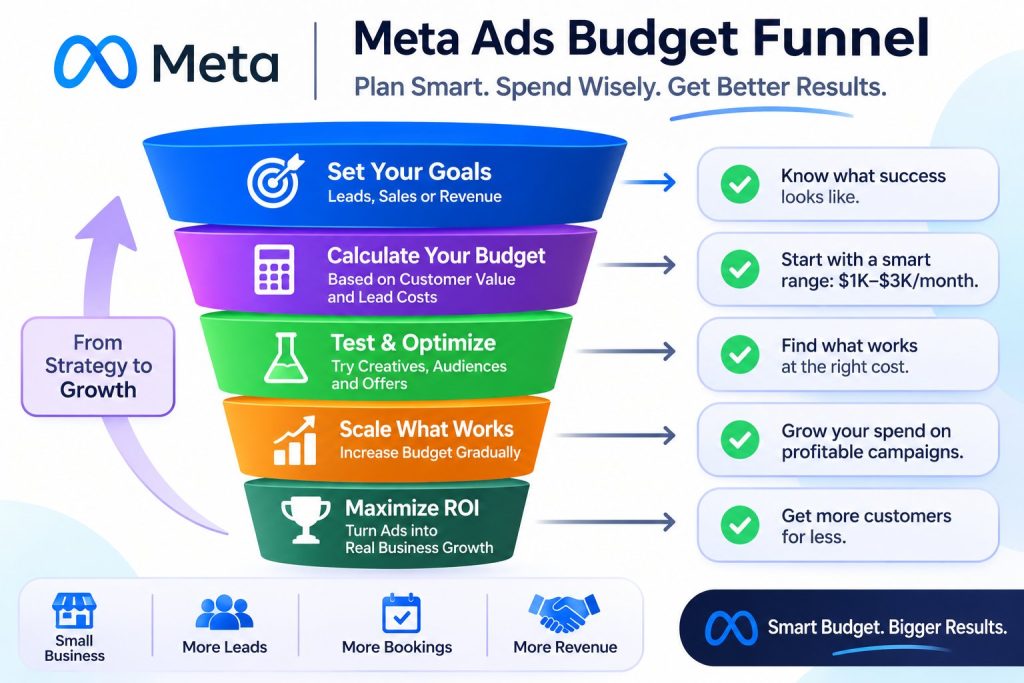
For many small businesses in the USA, a practical starting point is somewhere around $1,000–$3,000 per month in ad spend when the goal is lead generation. Businesses with smaller markets or strong existing demand may start lower, while businesses in competitive industries may need $3,000–$10,000+ per month to generate enough data and volume to scale.
These are planning ranges not guarantees.
The right Meta Ads budget depends on your offer, audience, creative, funnel, conversion rate, and sales process.
Why There Is No Universal Meta Ads Budget
Two businesses can spend the exact same amount on Meta Ads and get completely different results.
Consider two companies.
Business A
- $50 average customer value
- 5% lead-to-customer rate
- Low margin
Business B
- $5,000 average customer value
- 20% lead-to-customer rate
- High margin
Business B can potentially afford significantly more to acquire each customer.
That’s why copying another company’s advertising budget isn’t a reliable strategy.
Your budget should be connected to:
- Customer acquisition cost
- Average customer value
- Gross profit
- Lead quality
- Conversion rate
- Sales cycle
- Available market
- Capacity to handle new customers
The real question isn’t:
“How much do other businesses spend?”
It’s:
“How much can I profitably spend to acquire a customer?”
Recommended Meta Ads Budgets for Small Businesses
As a practical starting framework, small businesses can consider three levels.
| Monthly Ad Spend | Daily Average | Best For |
| $500–$1,000 | $17–$33/day | Small tests and narrow local markets |
| $1,000–$3,000 | $33–$100/day | Serious lead-generation testing |
| $3,000–$10,000+ | $100–$333+/day | Scaling proven campaigns |
A $500–$1,000 monthly budget can be useful for testing an offer, creative direction, or a highly localized campaign, but it may not generate enough volume for every business.
For many small businesses, $1,000–$3,000 per month provides a more useful starting range because it allows enough room to test multiple creative concepts and collect meaningful conversion data.
Once the business has a proven offer and predictable economics, a $3,000+ monthly budget can make sense.
The important point is that you shouldn’t jump directly to a large budget before proving that the funnel works.
Choose Your Budget Based on Your Business Model
Different businesses should approach Meta Ads differently.
Local Service Businesses
HVAC companies, plumbers, roofers, electricians, cleaners, painters, contractors, and similar businesses may start with a focused geographic audience.
A practical starting point can be around:
$1,000–$3,000/month
The goal is usually to generate:
- Calls
- Quote requests
- Estimate requests
- Appointment bookings
- Lead forms
The smaller the service area, the more important it becomes to monitor audience size and frequency.
Professional Services
Law firms, financial services, healthcare providers, consultants, and other professional services may require higher budgets because the customer value can be significantly higher but so can competition.
The focus should be on qualified leads, not simply maximizing form submissions.
E-Commerce
E-commerce businesses often need more testing because the campaign may depend on:
- Product-market fit
- Creative
- Product pricing
- Offer
- Landing page
- Average order value
- Repeat purchases
A small budget can test demand, but meaningful scaling usually requires enough volume to understand which products, audiences, and creatives are actually profitable.
B2B Businesses
B2B businesses often have fewer potential buyers and longer sales cycles.
Instead of measuring success only by cost per lead, track:
Lead → Qualified Lead → Meeting → Opportunity → Customer
A $100 lead may be excellent if it produces a $10,000 customer.
A $10 lead may be terrible if nobody is qualified.
Calculate Your Meta Ads Budget From Lead Economics
One of the simplest ways to establish a budget is to work backward from your target number of leads.
For example, suppose you want:
30 leads per month
and your expected target CPL is:
$40
Your initial media budget would be:
30 × $40 = $1,200/month
Now assume 20% of those leads become customers.
That’s:
30 leads × 20% = 6 customers
Your advertising cost per customer would be:
$1,200 ÷ 6 = $200
If your average gross profit per customer is $1,000, a $200 advertising acquisition cost may be attractive.
If your gross profit is only $150, the same campaign would not be sustainable.
This is why cost per lead is not enough.
You should understand:
CPL → Lead Quality → Close Rate → Customer Acquisition Cost → Revenue → Profit
How Much Should You Spend on Testing?
Don’t allocate your entire budget to one ad and one audience.
Your initial budget should allow you to test variables such as:
- Hooks
- Headlines
- Videos
- Images
- Offers
- Audiences
- Lead forms
- Landing pages
- Calls to action
For example, if you’re spending $2,000 per month, you might initially reserve a meaningful portion of the budget for testing while allowing the strongest campaigns to receive more spend.
The exact split depends on the account.
The goal is to discover:
Which audience responds?
Which creative gets attention?
Which offer generates qualified leads?
Which conversion path produces customers?
Once those answers become clearer, your budget can shift toward what is working.
Should You Use a Daily or Monthly Budget?
Think about your budget in monthly terms first.
For example:
$3,000/month
roughly translates to:
$100/day
This gives you a practical framework for planning cash flow and campaign pacing.
However, don’t assume every day will produce identical performance.
Advertising results fluctuate based on:
- Audience availability
- Competition
- Seasonality
- Creative performance
- Promotions
- Market demand
The goal is to evaluate performance over an appropriate period rather than making decisions based on one unusually expensive or unusually cheap day.
For evergreen campaigns, daily budgeting can provide flexibility.
For campaigns with a fixed promotion or specific end date, a lifetime budget may make more sense.
Don't Forget the Costs Beyond Ad Spend
Your Meta Ads budget isn’t necessarily your total advertising investment.
You may also need to budget for:
Creative
Video production, photography, graphic design, ad copy, and creative testing.
Landing Pages
A campaign can generate clicks without generating leads if the landing page is weak.
Tracking
You may need:
- Meta Pixel
- Conversions API
- Analytics
- UTM parameters
- CRM attribution
- Call tracking
CRM and Follow-Up
A lead that isn’t contacted quickly can become a wasted advertising expense.
Your CRM should capture leads and help your team manage follow-up.
Media Buying Management
If you hire a media buyer or agency, management fees are generally separate from your actual advertising spend.
This means a business spending:
$3,000/month on Meta Ads
might also have:
Media management + creative + landing page + CRM costs
Your total acquisition budget should account for all of these.
For a deeper explanation of agency pricing, see the upcoming Media Buying Services Cost: Pricing Models Explained article in this cluster.
Signs Your Meta Ads Budget Is Too Low or Too High
A budget may be too low when:
- You’re generating very few conversions
- There isn’t enough data to evaluate creative
- Results fluctuate dramatically
- You’re testing too many variables with too little spend
- The audience is large but you’re barely reaching it
- You can’t determine which campaigns are working
However, increasing the budget isn’t automatically the solution.
A budget may be too high when:
- Cost per lead is rising quickly
- Lead quality is declining
- The sales team cannot handle the volume
- Creative is becoming fatigued
- The offer isn’t converting
- Your landing page is the bottleneck
- Follow-up is poor
- You’re scaling an unprofitable campaign
If your campaign produces leads but those leads aren’t becoming customers, read Why Your Meta Ads Generate Leads but Not Customers before increasing spend.
More money amplifies whatever is already happening.
If the system works, scaling can amplify growth.
If the system is broken, scaling can amplify waste.
When Should You Increase Your Meta Ads Budget?
Increase your budget when you have evidence that the campaign can handle more volume profitably.
Look for:
- Consistent lead generation
- Acceptable cost per qualified lead
- Strong lead quality
- Predictable conversion rates
- Healthy sales capacity
- Accurate tracking
- Enough creative variation
- A working follow-up process
Don’t scale simply because you had one good day.
Look at the broader trend.
When you’re ready, increase spending gradually while monitoring:
CPL
Qualified Lead Rate
Appointment Rate
Customer Acquisition Cost
Revenue
ROAS
If you need help determining whether your campaign is ready to scale, see How to Audit Your Paid Media Campaigns Before Increasing the Budget.
And if you’re unsure whether you should manage campaigns yourself or bring in a specialist, When Should You Hire a Media Buyer Instead of Managing Ads Yourself? can help you evaluate that decision.
GrowthGuild’s Media Buyer team can help businesses plan, launch, monitor, and optimize paid campaigns while focusing on audience targeting, creative performance, budget management, and ROI.
The important thing is to treat Meta Ads as an acquisition system not simply a daily expense.
FAQs
1. How much should a small business spend on Meta Ads?
Many small businesses can start around $1,000–$3,000 per month for lead generation, while highly competitive businesses or companies ready to scale may need $3,000–$10,000+ per month.
2. Is $500 enough to run Meta Ads?
$500 can be enough for a small test, particularly in a narrow local market, but it may not provide enough data to evaluate every audience, creative, and conversion path.
3. What is a good Meta Ads budget for a local business?
A local business can often start around $1,000–$3,000 per month, depending on its service area, competition, customer value, and target number of leads.
4. Should I increase my Meta Ads budget if I get cheap leads?
Not necessarily. Before increasing spend, check lead quality, appointment rates, customer conversion, and customer acquisition cost. Cheap leads are only valuable when they can become profitable customers.
5. When should a small business scale its Meta Ads budget?
A business should consider scaling when it has consistent campaign performance, acceptable acquisition costs, qualified leads, accurate tracking, enough sales capacity, and a follow-up system capable of handling additional demand.