Local SEO for Home Service Businesses: How to Generate More Calls From Google
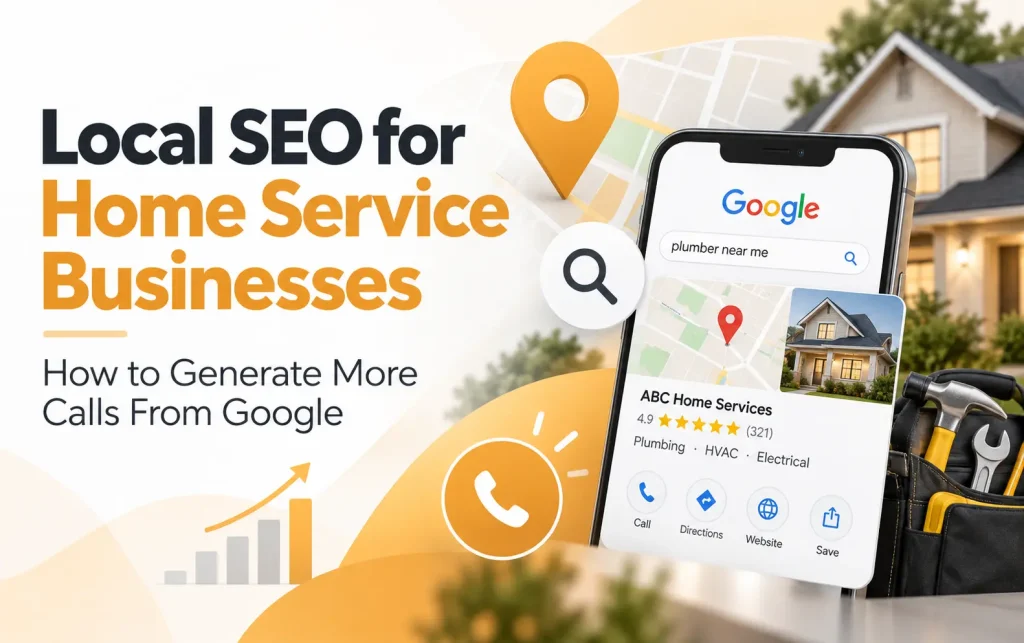
When someone searches Google for “Realtors Near Me,” “HVAC company near me,” “roofers in Dallas,” “plumber near me,” or “electrician in Phoenix,” they are often looking for a business they can contact immediately.
For home service businesses, showing up when these searches happen can mean more phone calls, quote requests, website visits, and customers.
This is where local SEO for home service businesses becomes important.
Local SEO helps businesses improve their visibility in location-based searches and Google Maps while making it easier for potential customers to find, contact, and trust them.
Although local SEO is particularly valuable for HVAC companies, plumbers, roofers, electricians, painters, contractors, and cleaning companies, the same principles can also benefit realtors, nonprofits and NGOs, and other organizations that serve specific geographic areas.
The goal isn’t simply to rank higher.
The goal is to turn local search visibility into real business opportunities.
What Is Local SEO?
Local SEO is the process of optimizing a business’s online presence so it can appear more prominently when people search for products or services in a specific geographic area.
For example:
“HVAC repair in Tampa”
“roofing contractor near me”
“house painters in Austin”
“real estate agent in Florida”
“commercial cleaning company in Denver”
These searches contain local intent because the person is looking for a business that can serve a particular location.
A strong local SEO strategy helps your business appear across relevant Google search results, Google Maps, your website, and other local discovery channels.
Why Local SEO Matters for Service Businesses
Home service customers often have an immediate problem.
Someone with a broken air conditioner may not want to spend hours researching HVAC companies. They may search Google, compare several local businesses, read reviews, and call the company that appears trustworthy and convenient.
The same applies to:
- Plumbers
- Roofers
- Electricians
- Painters
- General contractors
- Cleaning companies
If your competitors appear prominently while your business is difficult to find, potential customers may contact them instead.
Local SEO gives your business an opportunity to be visible during these high-intent searches.
1. Optimize Your Google Business Profile
Your Google Business Profile is one of the most important assets for local search visibility.
Make sure your profile information is accurate and complete.
Review:
- Business name
- Primary category
- Secondary categories
- Phone number
- Website
- Business hours
- Service areas
- Business description
- Services
- Photos
- Reviews
Your information should accurately represent what your business offers.
For example, an HVAC company shouldn’t simply list itself as a generic contractor if a more relevant category is available.
The same principle applies to plumbers, electricians, painters, cleaning companies, contractors, and realtors.
Keep your profile updated as your business changes.
2. Build Service-Specific Location Pages
One of the most common local SEO mistakes is having a single page that attempts to target every service and every location.
A better approach is to create useful pages around your actual services and markets.
For example, a roofing company serving multiple cities could have pages targeting relevant combinations such as:
Roof Repair in Phoenix
Roof Replacement in Scottsdale
Commercial Roofing in Mesa
These pages should contain genuinely useful information about serving those locations.
Do not simply replace the city name on the same page dozens of times.
Each location page should provide unique value.
3. Target Commercial Local Keywords
Not every keyword has the same business value.
Compare:
“How long does a roof last?”
with:
“roof replacement company near me.”
The first is informational.
The second has much stronger commercial intent.
Your local SEO strategy should target a mixture of informational and commercial keywords, but service businesses should pay particular attention to searches that indicate someone is ready to hire.
Examples include:
- HVAC repair near me
- Emergency plumber in [city]
- Roof replacement [city]
- Electrician near me
- House painters in [city]
- Cleaning company [city]
- General contractor [city]
- Real estate agent [city]
These searches can be highly valuable because they connect directly to services.
4. Get More Genuine Customer Reviews
Reviews can significantly influence how potential customers evaluate a local business.
Before contacting a company, people may compare:
- Star ratings
- Number of reviews
- Recent reviews
- Customer comments
- Business responses
Create a consistent process for requesting reviews from genuine customers after completing a job or service.
For example:
Job Completed → Customer Follow-Up → Review Request
Avoid purchasing fake reviews or creating reviews yourself.
Instead, make it easy for satisfied customers to share their actual experience.
Respond professionally to both positive and negative reviews.
A thoughtful response can demonstrate that the business pays attention to its customers.
5. Keep Business Information Consistent
Your business information should be consistent across important online properties.
Pay particular attention to:
- Business name
- Address
- Phone number
- Website
- Hours
Inconsistent information can create confusion for customers and make local SEO management more difficult.
This is especially important for businesses that have moved locations, changed phone numbers, rebranded, or created multiple locations.
Before building new citations, audit your existing information.
6. Create Content Around Local Customer Problems
Local SEO content shouldn’t be created simply to insert city names into blog posts.
Instead, answer questions that people in your market actually have.
For an HVAC company:
How to Know If Your AC Needs Repair or Replacement in [City]
For a roofing company:
What to Do After Storm Damage to Your Roof in [City]
For a painter:
How Much Does Exterior House Painting Cost in [City]?
For a cleaning company:
How Often Should You Schedule Professional House Cleaning?
For a realtor:
What Should Buyers Know Before Purchasing a Home in [City]?
This content can attract people earlier in the buying journey and introduce them to your business.
7. Optimize Your Website for Local Conversions
Getting visitors to your website is only part of the goal.
The website should make it easy for local prospects to contact you.
Include clear calls to action such as:
Request a Quote
Call Today
Schedule an Appointment
Book a Consultation
Get a Free Estimate
Make your phone number easy to find, particularly on mobile devices.
For home service businesses, consider adding:
- Service areas
- Customer reviews
- Before-and-after photos
- Certifications
- Guarantees
- Financing information
- Emergency service information
- FAQs
- Service-specific pages
The website should quickly answer three questions:
What do you do?
Where do you serve?
How can I contact you?
8. Make Your Website Mobile-Friendly
Many local searches happen when people are away from their computers.
A potential customer may search for a plumber while standing in front of a leaking pipe or look for an electrician from their phone.
Your website therefore needs to work well on mobile devices.
Check:
- Page loading speed
- Font size
- Navigation
- Buttons
- Forms
- Phone links
- Images
- Content layout
Make it easy for someone to call or submit a request without having to search around the page.
9. Use Local Business Structured Data
Structured data can help search engines better understand important information about your organization.
Depending on the business and page, relevant structured data can communicate information such as:
- Business type
- Name
- Address
- Phone
- Website
- Service information
- Location
For local businesses, structured data should support accurate information already present on the website rather than being used to add misleading information.
10. Build Relevant Local Authority
Local SEO is not only about your own website.
Your business may also benefit from being mentioned on relevant and trustworthy websites.
Potential opportunities include:
- Local business directories
- Industry organizations
- Chambers of commerce
- Local publications
- Community organizations
- Sponsorships
- Relevant partnerships
- Local news coverage
Quality matters more than simply collecting hundreds of directory listings.
A few relevant local references can be more useful than a large collection of unrelated websites.
Local SEO Strategies by Business Type
Different businesses should adapt local SEO to their customer journey.
HVAC Companies
Target searches around:
- AC repair
- HVAC installation
- Furnace repair
- Emergency HVAC
- Maintenance
- Specific service areas
Create dedicated pages for important services and locations.
Plumbers
Focus on high-intent searches such as:
- Emergency plumbing
- Drain cleaning
- Water heater repair
- Leak detection
- Sewer services
Make emergency contact information highly visible.
Roofers
Build content around:
- Roof repair
- Roof replacement
- Storm damage
- Commercial roofing
- Roof inspections
Location-specific service pages can be particularly useful when targeting multiple markets.
Electricians
Consider targeting:
- Emergency electrician
- Electrical repair
- Panel upgrades
- Wiring
- Lighting installation
- Commercial electrical services
Painters
Target:
- Interior painting
- Exterior painting
- Commercial painting
- Cabinet painting
- House painting
Location-specific cost and service content can also attract potential customers.
Contractors
General contractors can create pages around specific project types and geographic markets.
Examples include:
- Home remodeling
- Kitchen remodeling
- Bathroom remodeling
- Additions
- Commercial construction
Cleaning Companies
Useful local search opportunities include:
- House cleaning
- Deep cleaning
- Move-out cleaning
- Commercial cleaning
- Office cleaning
Realtors
Real estate professionals can target searches around:
- Realtors in [city]
- Homes for sale
- Neighborhood guides
- Buyer services
- Seller services
- Local market information
Useful local content can establish expertise while attracting potential buyers and sellers.
NGOs and Nonprofits
Local SEO can also help NGOs and nonprofits become more discoverable within the communities they serve.
They can optimize for searches related to:
- Local programs
- Community services
- Volunteer opportunities
- Donation opportunities
- Local events
- Support services
The strategy should focus on accurately communicating the organization’s mission, location, programs, and community impact.
Read more about: SEO Services Cost for a Small Business in the USA
How to Turn Local SEO Traffic Into Leads
Ranking is not the final objective.
A successful local SEO strategy should create a path from search to conversion.
For example:
Google Search
↓
Google Business Profile / Website
↓
Service Page
↓
Call / Form / Booking
↓
CRM
↓
Automated Follow-Up
↓
Sales Opportunity
This is where SEO can connect with CRM and automation.
For example, a home service business can capture a website inquiry, automatically send a confirmation message, notify the sales team, and continue appropriate follow-up through its CRM.
This means SEO isn’t operating in isolation.
SEO generates visibility.
The website generates inquiries.
CRM and automation help turn inquiries into opportunities.
How Long Does Local SEO Take?
There is no guaranteed timeline for local SEO results.
Some improvements can occur relatively quickly after fixing technical problems, optimizing business information, or improving existing pages.
More competitive markets can require considerably more time and consistent effort.
Results depend on factors such as:
- Local competition
- Website authority
- Current rankings
- Technical SEO
- Content quality
- Reviews
- Business prominence
- Location
- Search demand
- Consistency of optimization
A strong local SEO strategy should therefore be treated as an ongoing investment rather than a one-time ranking project.
Common Local SEO Mistakes
Avoid these common problems:
Creating Duplicate Location Pages
Don’t create dozens of nearly identical pages with only the city name changed.
Ignoring Google Business Profile
Your website isn’t the only place customers discover you.
Buying Fake Reviews
Reviews should come from real customers.
Targeting Only Broad Keywords
Focus on specific services and locations with commercial intent.
Ignoring Mobile Users
Make calling and submitting forms easy from a phone.
Publishing Content Without a Strategy
Every article should support a customer question, service, location, or business objective.
Tracking Rankings Without Leads
Traffic and rankings are useful, but calls, inquiries, appointments, and customers are ultimately more important.
Final Thoughts
Local SEO for home service businesses is about much more than ranking for a few keywords.
HVAC companies, plumbers, roofers, electricians, painters, contractors, cleaning companies, realtors, NGOs, and other local organizations need to be visible when people are actively searching for the services or support they provide.
A strong strategy combines:
Google Business Profile + Local Keywords + Service Pages + Location Pages + Reviews + Technical SEO + Local Content + Conversion Optimization
But visibility is only the first step.
The real opportunity comes when local search traffic is connected to a strong website, CRM, lead-management process, and follow-up system.
Get More Local Leads With GrowthGuild
If your business is ranking below competitors, receiving inconsistent traffic, or getting website visitors without enough calls and inquiries, GrowthGuild can help.
Our SEO team can build a local search strategy around your services, locations, competitors, and business goals from technical SEO and keyword research to service pages, local optimization, Google Business Profile strategy, content, and conversion focused improvements.
We can also connect your SEO-generated leads with CRM, automation, and follow-up systems so your team has a better process for turning local searches into real opportunities.
Want more calls from Google? Talk to GrowthGuild about a local SEO strategy built to generate leads, not just rankings.
Contact GrowthGuild today for your SEO strategy.
FAQs
1. What is local SEO for home service businesses?
Local SEO helps home service businesses appear in relevant Google Search and Maps results when customers search for services in their area.
2. How can local SEO generate more calls?
Optimizing your Google Business Profile, service pages, local keywords, reviews, and website conversion paths can help more potential customers discover and contact your business.
3. Which home service businesses benefit from local SEO?
HVAC companies, plumbers, roofers, electricians, painters, contractors, cleaning companies, and other businesses serving specific geographic areas can benefit from local SEO.
4. Is Google Business Profile important for local SEO?
Yes. A complete and accurate Google Business Profile helps customers find important business information and discover the business through Google Search and Maps.
5. How long does local SEO take to work?
There is no guaranteed timeline. Results depend on competition, location, website authority, technical SEO, content, reviews, and the consistency of optimization.