GoHighLevel Workflow Mistakes That Cause Duplicate Messages and Broken Automations
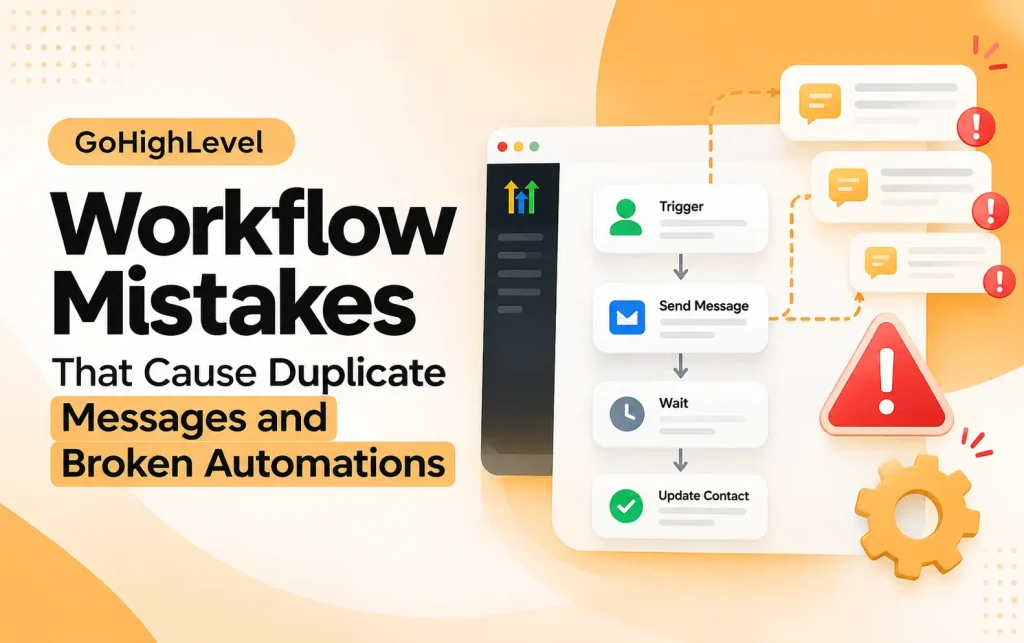
Automation is one of the biggest advantages of using GoHighLevel. Businesses and agencies use GHL automations to capture leads, send follow-ups, manage appointments, update pipelines, onboard customers, and improve communication.
However, poorly configured workflows can create the opposite result.
Duplicate SMS messages, incorrect follow-ups, missed notifications, broken triggers, and confusing customer experiences are common issues when GoHighLevel workflows are not structured correctly.
A single automation mistake can cause:
- Customers receiving multiple messages
- Leads entering the wrong pipeline
- Sales teams missing important notifications
- Workflows triggering at the wrong time
- Internal processes becoming difficult to manage
This is why working with an experienced GoHighLevel expert is valuable. Proper workflow architecture ensures automations support your business instead of creating operational problems.
In this guide, we will cover the most common GoHighLevel workflow mistakes and how to prevent them.
1. Creating Multiple Triggers for the Same Action
One of the most common causes of duplicate messages is having multiple workflows triggered by the same event.
For example:
A lead submits a Facebook form.
Workflow A:
- Sends welcome SMS
Workflow B:
- Sends new lead notification
Workflow C:
- Sends another welcome message
The result:
The customer receives multiple messages within seconds.
Before creating new workflows, review existing automations and check whether the action already exists somewhere else.
A well-organized GoHighLevel account should have clear ownership of each automation.
2. Using Broad Triggers Without Conditions
Triggers decide when a workflow starts.
A common mistake is creating broad triggers without additional filters.
Example:
Trigger:
“Contact Created”
Action:
Send sales follow-up sequence.
The problem is that every new contact entering the CRM will receive that sequence, including:
- Existing customers
- Imported contacts
- Employees
- Test records
- Unqualified leads
A better approach is adding conditions such as:
- Lead source
- Tags
- Pipeline stage
- Custom fields
- Contact type
Specific triggers create more reliable GHL automations.
3. Forgetting Workflow Goals
Workflow goals determine when automation should stop.
Without goals, a customer may continue receiving messages even after completing the desired action.
Example:
A prospect enters an appointment booking workflow.
They schedule a meeting.
However, because there is no workflow goal:
- Reminder emails continue
- Follow-up SMS messages continue
- Sales sequences continue
This creates a poor customer experience.
Every workflow should have a clear completion point.
Examples:
- Appointment booked
- Form completed
- Deal won
- Customer replied
- Payment received
4. Not Using Proper Workflow Naming
As agencies grow, workflow organization becomes extremely important.
Many businesses create workflows with unclear names such as:
- New workflow
- Test automation
- Follow-up sequence
- SMS campaign
After dozens of workflows are created, nobody knows what each automation does.
A better naming structure:
Service – Trigger – Purpose
Examples:
- Dental – New Lead – SMS Follow Up
- Roofing – Appointment – Reminder Sequence
- SaaS – Trial User – Activation Workflow
Clear naming makes troubleshooting easier for your team and future GoHighLevel experts.
5. Building Too Many Separate Workflows
More workflows do not always mean better automation.
A common mistake is creating separate workflows for every small action.
Example:
- Workflow 1:
Send email - Workflow 2:
Send SMS - Workflow 3:
Create task - Workflow 4:
Apply tag - Workflow 5:
Update pipeline
This can create unnecessary complexity.
Instead, combine related actions into a logical workflow whenever possible.
A cleaner workflow is easier to manage, test, and optimize.
6. Ignoring Workflow Priority
Sometimes multiple workflows can run at the same time.
Example:
A lead enters from an advertisement.
Three workflows trigger:
- Lead nurturing
- Sales follow-up
- Appointment campaign
Without proper planning, these workflows may compete with each other.
A GoHighLevel expert usually reviews:
- Trigger order
- Workflow conditions
- Contact movement
- Exit rules
This ensures the right automation runs at the right stage.
7. Importing Contacts Without Understanding Triggers
Many businesses experience automation problems after importing large contact lists.
For example:
A company imports 10,000 contacts.
A workflow trigger detects new contacts.
The system starts sending messages to the entire database.
This can result in:
- Duplicate communication
- Compliance issues
- Customer complaints
Before importing contacts:
- Disable unnecessary workflows
- Review trigger conditions
- Test with sample contacts
- Confirm import settings
8. Not Testing Workflows Before Launch
Launching automation without testing is one of the biggest mistakes.
Every workflow should be tested using different scenarios.
Test:
New Lead
Is the correct message sent?
Existing Customer
Does the workflow ignore them?
Appointment Booking
Does the reminder sequence stop correctly?
Reply Received
Does the conversation route correctly?
Testing identifies problems before customers experience them.
9. Poor Tag Management
Tags are powerful inside GoHighLevel, but inconsistent tagging creates confusion.
Example:
Different team members create:
- New Lead
- New Leads
- New_Lead
- Lead-New
These all represent the same thing but create unnecessary complexity.
Create a tag structure and keep it consistent.
Example:
Source Tags:
- Facebook Lead
- Google Lead
- Website Lead
Status Tags:
- Qualified Lead
- Appointment Booked
- Customer
Service Tags:
- SEO Client
- CRM Client
- Ads Client
10. Incorrect Pipeline Automation
Pipelines help teams understand where leads are in the sales process.
However, incorrect automation can move opportunities incorrectly.
Example:
A workflow automatically moves every contact to “Qualified.”
The sales team assumes every lead is ready.
This creates inaccurate reporting.
Pipeline movement should happen based on real actions:
- Form completion
- Qualification answers
- Appointment booking
- Sales confirmation
11. Forgetting External Integration Issues
Many GoHighLevel workflows depend on external tools.
Examples:
- Facebook Lead Ads
- Calendars
- Zapier
- Make
- Payment systems
- Websites
When integrations break, workflows may stop functioning.
Regularly check:
- Connection status
- API permissions
- Field mapping
- Error logs
12. Using Generic Messages Instead of Personalization
Automation should save time without making communication feel robotic.
Poor message:
“Hello, we received your inquiry. Contact us.”
Better message:
“Hi John, thanks for reaching out about your roofing estimate. We received your request and our team will help you schedule your inspection.”
Personalization improves engagement and creates a better customer experience.
13. Not Maintaining Workflows Regularly
Automation systems require maintenance.
Businesses change:
- Offers
- Team members
- Calendars
- Services
- Sales processes
An outdated workflow can create problems months after it was created.
Review workflows regularly:
- Remove unused automations
- Update messages
- Check triggers
- Review performance
- Fix errors
How a GoHighLevel Expert Helps Prevent Automation Problems
Building workflows is easy.
Building reliable automation systems requires strategy.
A GoHighLevel expert understands:
- Customer journeys
- CRM structure
- Workflow logic
- Pipeline management
- Lead qualification
- Integration setup
- Automation testing
They can audit existing systems, identify problems, remove duplicate workflows, and create scalable automation frameworks.
For agencies managing multiple clients, proper workflow organization is even more important.
Best Practices for Reliable GHL Automations
Follow these principles:
- Use specific triggers
- Add workflow goals
- Keep naming conventions consistent
- Test before launching
- Avoid duplicate workflows
- Document automation logic
- Review workflows regularly
- Maintain clean tags and pipelines
A well-built automation system should reduce complexity, not increase it.
Final Thoughts
GHL automations can transform how businesses manage leads, customers, and internal operations. However, incorrect workflow setup can lead to duplicate messages, broken processes, and frustrated customers.
The key is creating structured automation systems with clear triggers, conditions, goals, and maintenance processes.
Whether you are building a CRM for your own business or managing multiple client accounts, working with an experienced GoHighLevel expert can help ensure your automation infrastructure remains reliable and scalable.
GrowthGuild helps agencies and businesses build GoHighLevel CRM systems, optimize workflows, and create automation frameworks that improve customer acquisition and operations.
Need help fixing or building your GoHighLevel workflows? Contact GrowthGuild to optimize your automation system.
GHL FAQs
1. What are GHL automations?
GHL automations are GoHighLevel workflows that automatically manage tasks like lead follow-ups, appointment reminders, customer communication, and CRM updates.
2. Why are my GoHighLevel workflows sending duplicate messages?
Duplicate messages usually happen because multiple workflows have similar triggers or because workflow goals and exit conditions are missing.
3. How can a GoHighLevel expert fix broken automations?
A GoHighLevel expert can audit workflows, review triggers, remove conflicts, fix integrations, and rebuild automation logic.
4. How often should GoHighLevel workflows be reviewed?
Businesses should review important workflows regularly, especially after changing offers, team members, processes, or integrations.
5. Can GHL automations improve lead conversion?
Yes. Properly configured GHL automations can improve response times, follow-ups, appointment bookings, and lead management efficiency.